Search - Miles Davis :: Kind of Blue

Kind of Blue
Miles Davis
Kind of Blue
Genre: Jazz
 
  •  Track Listings (5) - Disc #1

This is the one jazz record owned by people who don't listen to jazz, and with good reason. The band itself is extraordinary (proof of Miles Davis's masterful casting skills, if not of God's existence), listing John Coltra...  more »


Larger Image
Listen to Samples

CD Details

All Artists: Miles Davis
Title: Kind of Blue
Members Wishing: 0
Total Copies: 22
Label: Sony
Release Date: 10/25/1990
Genre: Jazz
Styles: Modern Postbebop, Bebop
Number of Discs: 1
SwapaCD Credits: 1
UPCs: 074644057928, 074644057942, 074644057980, 074646493526

Synopsis

Amazon.com essential recording
This is the one jazz record owned by people who don't listen to jazz, and with good reason. The band itself is extraordinary (proof of Miles Davis's masterful casting skills, if not of God's existence), listing John Coltrane and Julian "Cannonball" Adderley on saxophones, Bill Evans (or, on "Freddie Freeloader," Wynton Kelly) on piano, and the crack rhythm unit of Paul Chambers on bass and Jimmy Cobb on drums. Coltrane's astringency on tenor is counterpoised to Adderley's funky self on alto, with Davis moderating between them as Bill Evans conjures up a still lake of sound on which they walk. Meanwhile, the rhythm partnership of Cobb and Chambers is prepared to click off time until eternity. It was the key recording of what became modal jazz, a music free of the fixed harmonies and forms of pop songs. In Davis's men's hands it was a weightless music, but one that refused to fade into the background. In retrospect every note seems perfect, and each piece moves inexorably towards its destiny. --John Szwed

Similarly Requested CDs


Member CD Reviews

Ken D. (Allthatjazz)
Reviewed on 4/11/2009...
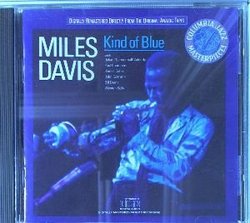
This 1987 version not only has the still incorrect speed on several tracks, but a sloppy cover photo with a reversed negative, showing Miles playing trumpet left handed, with the valves on the wrong side of the instrument.

There is no reason to own this edition, get a later version on CD with the speed correction and the original cover photo.
10 of 10 member(s) found this review helpful.
Mark R. from LONGMEADOW, MA
Reviewed on 10/29/2006...
The jazz disc that gets more respect than anything else. And more than I can understand, actually.
0 of 1 member(s) found this review helpful.
Steve H. from FAYETTEVILLE, NC
Reviewed on 9/1/2006...
Best selling jazz album of all time, and justifiably so.
1 of 1 member(s) found this review helpful.

CD Reviews

About as good as jazz gets...
finulanu | Here, there, and everywhere | 08/19/2007
(5 out of 5 stars)

"Admit it, you've heard of this album, even if you're not a jazz fan. And why not? It's certainly THE Miles Davis album to own - if you're only to have one, make it this. It's arguably my favorite jazz album, rivaled only by Coltrane's A Love Supreme. Coltrane himself plays on this album, and his playing alone makes this an essential album. Than again, so does everything about the album: Miles' most famous song is found here, the bluesy So What, a longtime favorite of mine. You've probably heard all about the well-known modal melody and bass-piano tradeoff during the beginning, but my favorite part is Cannonball Adderly's sax solo, which makes excellent use of trills, giving it an almost Medieval sound. Following it up is Freddie Freeloader, which takes a similar melody and emphasizes the blues element of the song: Wynton Kelly does a great job at the keys. The third and final blues song is All Blues, a demonstration of the awesome chemistry between the group's horn section of Miles, Trane, and Cannonball.
Then there are your ballads, both total classics in their own right: Blue in Green (penned by pianist Bill Evans, the only song not by Miles) is a lovely, restrained song: Cannonball takes a break, Miles plays a wonderful muted trumpet solo; Coltrane does his usual "restrained emotion" thing; Evans (who gets in a short but amazing piano solo near the end), Paul Chambers and Jimmy Cobb provide a restrained but tight rhythm section. Lastly comes Flamenco Sketches, in truth the weakest song on this album - but I'd still rate it five stars, which says a lot about what we're dealing with here. It's actually modal free jazz in a way, since it contains no melody and allows Miles, Trane, Cannonball and Evans to improvise over a simple bass vamp and quiet drum part.
What more can I say? It's Kind of Blue. It's a legendary album. If you don't have it, you're really missing something."
KIND OF BLUE: new improvisational standard
J. Holmes | yokohama, japan | 09/25/2005
(5 out of 5 stars)

"for people who have a spark of curiosity about the legendary music of Miles Davis, knowing where to begin the search can be a frustrating issue. with a back catalogue as vast as a small continent, figuring out where to start and where to go can be tricky. especially considering the many phases of Miles' long and adventerous career. he spawned many folowers and imitators and made many enemies along the way. a larger than life figure who would dominate the jazz scene for decades and whose music still holds power and brilliance even to this day. Personally, i have been such a big John Coltrane fan for so many years, that i somehow blindly overlooked Miles Davis' recorded output for a long time. it's just been in the past 4 years or so that i have gotten the opportunity to dig into Miles' absolutely stunning and quite frankly, overwhelming music. whereas Coltrane was the master of melody, Miles is the master of the mood. a true genius whose musical impact and influence is felt even stronger today than it was when he was alive.

Kind Of Blue is not just a landmark Miles Davis album, but a monumental recording in the history of music. Kind of Blue is the album that most people who don't even like jazz own in their collection. why is that? well, perhaps it's the simple stated themes of quiet beauty that people are drawn into. this is late night early morning jazz. this is reflective music for those quiet moments. it's the kind of jazz that the house band plays as the last set of a long night. it's melodies are deep and shaded with dark hues and tones. the sound weaves a mysterious web that draws the listener in and reveals a whole new phrasing with each listen. that's part of the genius appeal of Miles Davis. his music is a sketch of an idea. the players fill in some of the blanks with their own ideas and thoughts, but alot is left open wide for the listener to dive right in and allow their own imaginations to explore the audio space. Kind Of Blue is a hauntingly good album and a classic piece of exquisite brilliance in motion."